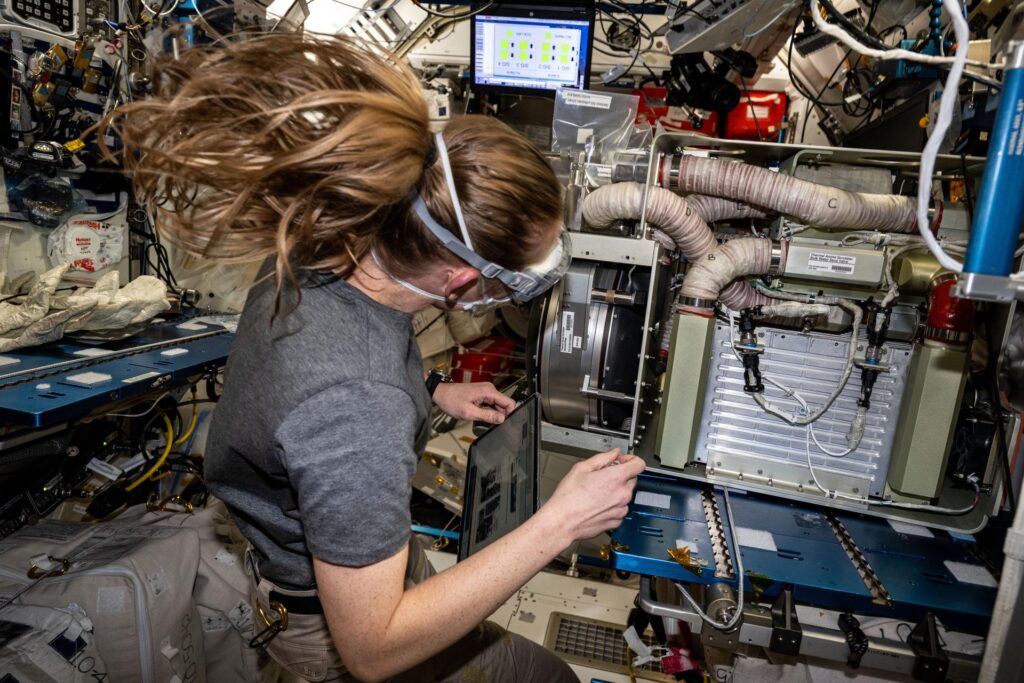
NASA astronaut Nichole Ayers replaces components on a Thermal Amine Scrubber. Credit: NASA.
Introduction
Sustainspace has long covered space life support, which has largely focused on the International Space Station (ISS) and on proposed aspirational crewed spacecraft. However, for the first time in a long time, there has been a crewed deep space mission, the Artemis missions.
Thus far, flown Artemis crewed hardware is limited to the Orion capsule, provided by Lockheed Martin. The Orion is larger than the previous Apollo crewed lunar capsules. While the technology on the Orion capsules is not particularly ground-breaking, it is of interest, and provides a good review of human requirements for missions of about a week or so in duration.
The chief requirements for human to endure in a non-Earth, closed environment are oxygen for metabolism, CO2 removal to avoid poisoning, water to drink, food for energy, and human waste removal to avoid excessive distractions. There are other nice-to-haves, but this article focuses mostly on the core necessities.
Oxygen Supply and CO2 Removal;
According to Lockheed, “the Air Revitalization System on Orion maintains appropriate oxygen levels while removing carbon dioxide and trace contaminants generated by crew and onboard equipment.” Functionally, “oxygen and nitrogen are supplied from storage tanks, while carbon dioxide is captured using a regenerative chemical scrubbing technology called amine swing beds” (Lockheed, 2026).
The thermal amine scrubber (also simply called an “amine scrubber”) uses beaded porous materials (“molecular sieves”) as adsorbent materials to filer out carbon dioxide (NASA, 2021). The molecular sieves can be cleaned out of carbon dioxide by exposing it to the vacuum of space, and then reused (NASA, August 2026). A unit the size of a small refrigerator has been developed for flight use (NASA, 2021).
Why is there nitrogen? Ever since a fire in Apollo 1, nitrogen has been included in spacecraft atmospheres to help prevent explosive fires. It also reduces dizziness from breathing pure oxygen.
Water
The Orion Potable Water System water supply “provides drinking water for food preparation, medical needs and hygiene activities during the mission,” and “Orion can carry about 74 gallons of water in its four tanks.” Apparently water is not supplied by recycling or field cells, since “Orion’s humidity control system captures excess humidity” such as from crew respiration, and “converts it to liquid water and stores it as wastewater for disposing” (Lockheed, 2026).
Human Waste
Most of what goes into humans eventually comes out. Astronauts are no exception. Toilet and related hygiene facilities quickly move from a matter of mere comfort to necessity as flight time increases. Flights to the Moon and back approach the latter! So, Orion has “facilities”. “Orion’s Universal Waste Management System (WMS), or toilet, is nearly identical to what astronauts already use on the ISS” and “has a dedicated hygiene bay, or bathroom, for privacy while using the WMS”, (Lockheed, 2026).
Analysis
Decisions concerning how to provide life support (LS) typically involve tradeoffs between mass of equipment versus mass of consumables. The longer the mission, the greater is the mass of oxygen, water, food, etc. that astronauts consume. Equipment can presently be provided that help recycle oxygen and water, but this equipment itself has a significant mass. So short missions, favor expendable consumables, whereas longer ones favor more recycling (also called closed loop). Orion missions to the Moon and back typically take a week or longer, but are much shorter than typical ISS missions, so they lean towards expendable consumables. In the future, if lunar missions become longer, this balance will change.
Another tradeoff is volume. Earth-orbit space stations, such as the former Skylab and the present international Space Station (ISS) have relatively large quantities of volume available for both life support equipment expendables and recycling equipment. However, missions to the Moon involve much smaller volumes, so that space inside of the spacecraft is at a premium. This might be the case for crewed missions to Mars, as well. The question becomes how small can you make recycling equipment? Energy and thermal management can involve additional tradeoffs that are beyond the scope of this article.
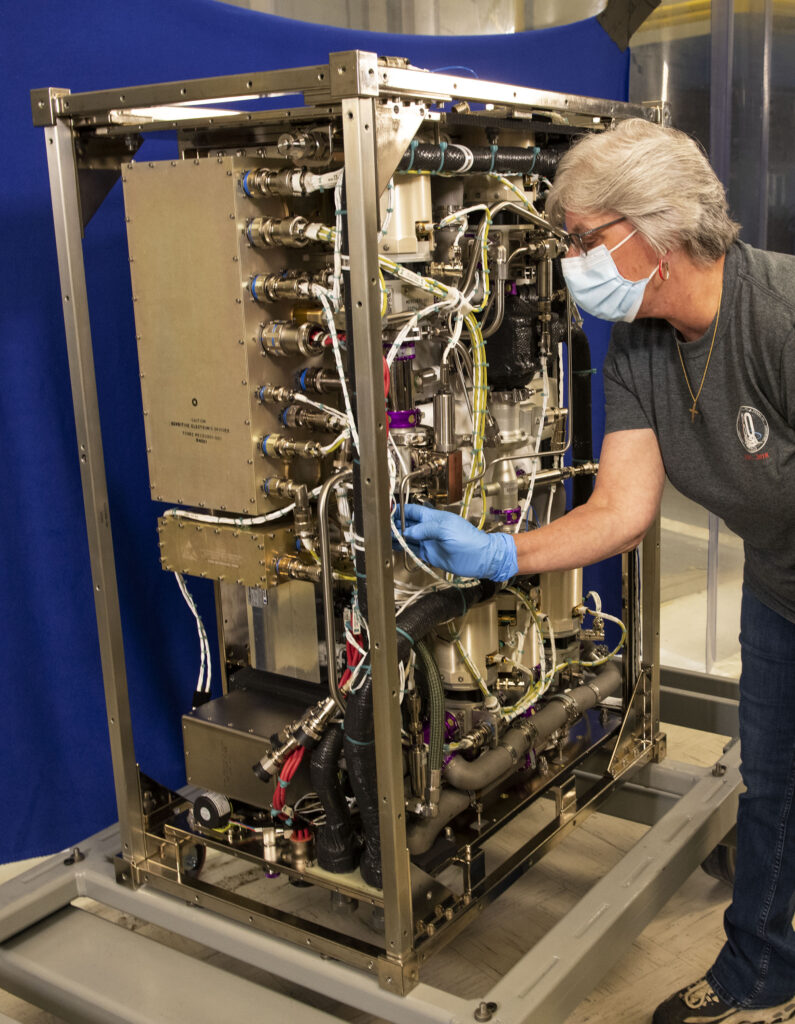
4-Bed Carbon Dioxide Scrubber at NASA’s Marshall Space Flight Center, checked out by Kathi Lange, a Bastion Technologies contractor supporting the quality assurance. Credit: NASA/Fred Deaton.
References
Lockheed Martin, “Surviving Deep Space: A Look at the Orion Spacecraft Life Support Bubble“, website, April 8, 2026.
NASA, “Episode 179: Life Support Systems: From Space Station to Orion“, website, August 5, 2026.
NASA (Lee Mohon), Marshall Ships Next-Generation Air Filtration Hardware to Wallops for Flight to International Space Station, website, June 10, 2021.
Further Reading
NASA, Food & Nutrition, website, last viewed on August 22, 2026.
NASA, Life Support Subsystems, website, last viewed on August 22, 2026.