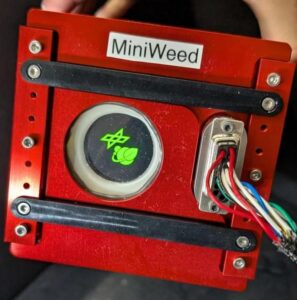
Miniweed device (credit U. of Adelaide)
Duckweed is a low-key pond plant used for food in Southeast Asia. Yet, despite its tiny size, duckweed has several nutritional and growing characteristics that make it of high interest for use in space. Several endeavors are seriously examining duckweed as an important component of the diets of future astronauts, including a planned launch to the Moon.
Challenges To Feeding Astronauts With Plants
Feeding astronauts in space can be a challenge. Food brought from Earth involves tremendous transportation expense, is not very fresh and is highly preserved. Producing food in space can help avoid transportation costs, but invokes its own challenges. There are no facilities for raising cattle or chickens, or anything close to that. Plants are a logical alternative, in that many of species can be grown in smaller areas, and have less chance of carrying illnesses that affect humans.
Yet plants involve challenges as well. Growing even plants in sufficient quantities takes up much more extensive volumes than are available on present and planned facilities in space. There is no room for Earth-sized fields of wheat or an apple orchard. Another major factor is growing cycles. Many Earth crops are raised in annual cycles. Although there are no seasons in space, many plants take months to produce seeds or sufficient vegetation. Caring for crops can involve extensive labor. Astronauts do not have time for that level of effort, and bringing along additional astronauts to be farmers might increase the demand for food to more than the additional personnel can produce given other constraints. Part of the labor is pollination. On Earth, bees and other inspects pollenate many of our crops. In insect-free environments, botanists can hand-pollinate plants, but that is a lot of labor if a lot of plants are involved.
Duckweed
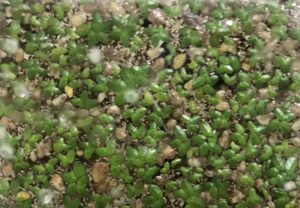
Duckweed plants (Sustainspace Lab)
In the plant world, duckweed is a paradox. It is a tiny, often-ignored plant that grows in the backwaters of lakes and swamps. It is often viewed as an aquatic weed, but is nevertheless used as food primarily in Southeast Asia, but also elsewhere such as in the United States. Though one of the smallest plants, it can have the fastest reproduction and growth rates. Under optimal conditions, Duckweed biomass can double every 2–3 days. Like most plants, duckweed can reproduce through flower and seeds. More importantly, thought, it can also reproduce in a monoclonal manner, which means growing by offshoots. This means it does not need to be pollinated, saving significant labor in space. Consequently, duckweed is a potential superfood for space in that it solves several problems related to growing food in space as well as nutritional challenges.
Nutritional Benefits of Duckweed on Earth
Duckweed contains many nutrients. “Duckweed contains “about 35% carbohydrates, 20% minerals, and up to 40% protein”. (Alberta Institute for Wildlife Conservation, 2023). It has a high amount of protein considering its weight, especially when it is in the form of a dried powder. “With its high protein content (up to 45%) and a rich supply of antioxidants, amino acids, and Omega-3s, the crunchy vegetable is sometimes called a superfood.” (Pekar, 2020).
Advantages and Disadvantages
Duckweed also offers several advantages for growing in space. It not need to be pollenated. Given the lack of bees in space, this would be a major timesaver. For most other plants, astronauts will have to do the pollination work of bees, and astronauts have better things to do with their time. Each duckweed plant takes up very little volume. That means it can be grown in small, stackable chambers. It is attractive as a green vegetable. As noted above, duckweed is also high in nutrients, including protein. Duckweed can be dried for later use. Also it pulls nitrogen from nutrient solution or gel, not from air.
Disadvantages include that the smaller varieties can be a bit challenging to harvest and cull out. Also, since there is no gravity to provide Earth-like flat pond surfaces, the duckweed might need to be grown in a gel when in the microgravity environment of space stations. Further, despite the high protein and carbohydrate levels of duckweed, observations suggest that few people will want to it exceed 10–20% of their diet. Sustainspace Lab research shows that some individual duckweed plants die off, resulting in difficulties harvesting just live plants.
Who Is Working on Duckweed for Space?
Recent Yeats have seen a dramatic increase in interest by researchers and endeavors to explore the use of duckweed as astronaut food. Duckweed has been flown on at least two suborbital rocket flights with plans for future flights to the Moon. Several of these endeavors are discussed here.
University of Adelaide’s MiniWeed experiment
On 11 November, 2024, University of Adelaide’s MiniWeed experiment (pictured at the top of this article), conducted in collaboration with DLR and Melbourne’s La Trobe University, was launched in a sounding rocket to test how altered gravity affects duckweed (Wolffia australiana). This project is part of the ARC Centre of Excellence in Plants for Space (PS4) program. (Von Einem, 2024; ABC, 2024).
“We are excited to reach this major milestone of launching a sample of Wolffia australiana in a sounding rocket experiment,” says the University of Adelaide’s Associate Professor Jenny Mortimer, Chief Investigator at Plants for Space (P4S).
The collaborator at the DLR, Dr Jens Hauslage, has designed an experimental system that will chemically pause the plant’s development at two points in the rocket’s journey: the end of the hypergravity phase, and the end of the microgravity experiment. Hauslage explains “once we retrieve the samples, we will look at the effects of the altered gravity on the plant biology, in particular, gene expression.” Following the launch, Associate Professor Mortimer has been working with La Trobe’s Professor Mathew G. Lewsey to analyse the biological and molecular effects on the duckweed, which will help the researchers prepare for future launches to deep space (Von Einem, 2024).
Space Lab Technologies
Space Lab Technologies, LLC., located in Colorado, is one of the earlier ventures involved with research and development for duckweed in space. During 2020–2023, their µG-Lilypond growth chamber was launched on two missions. (Space Lab website). The Lilypond growth chamber was flown on a Blue Origin rocket suborbital flight (Pekar, 2020). They have received several SBIR awards for this work. Christine Escobar is a Principal Investigator on several of their projects.
“Space Lab zeroed in on duckweed (also known as water lentils) – as their test crop. Escobar has said these rapidly growing plants are ideal for space because they do not require soil or another growing media – which means fewer materials, less mass, and less waste for resource-intensive space missions. But realizing the promise of such plants requires the right technology” (Pekar, 2020). Space Lab has environmentally engineered the Lemnaceae family of duckweed to produce LilyPond Water Lentils™ with enhanced yield and nutritional quality. (Space Lab web page).
The Lilypond growth chamber comprises: “closely stacked shallow growth trays provide a stable water surface on which the plant grows, with water delivered via open capillary channels and LED panels providing an efficient light source. When the plants are ready to eat, a rotary sieve separates them from the water, which can be recycled for the next crop” (Pekar, 2020). Space Labs is also working towards growing duckweed on the Moon as part of the Artemis mission series.
Duckweed Labs, Inc.
Several students at universities across the United States came together to form Duckweed Labs. This group won last year’s NASA Proposal Writing and Evaluation Experience (NPWEE) contest and a US $10,000 team prize.
Principal Investigator Thomas Liu indicated that he had the idea of duckweed prior going into the competition. Did their group consider algae? Yes, and seaweed and kelp. However, those species did not have a high protein content. Liu told Sustainspace that, during a 2023 high school assignment on how plants breed, he was impressed by duckweed’s high population growth rate, and high protein level. (Liu interview, 2025; Duckweed Labs website).
A goal for their NASA project is to maximize production: its growth rate, e.g. in same space. A technical challenge they are facing is how to supply nutrients and water to the duckweed. Duckweed Labs reports that is has moved beyond the scientific aspects to engineering challenges and machinery. Presently, they are working on a Duckweed Protein Supplement Dispenser (DPSD), a compact bioreactor that will cultivate, process, and dispense duckweed-based nutrition for astronauts.
Duckweed Labs Updates:
- They recently received a second NASA grant (US $20,000) to develop the Intelligent Growth Chamber for Precision Farming (IGCPF) web link
- They were just accepted into Georgia Tech’s Southeast Analog Mission
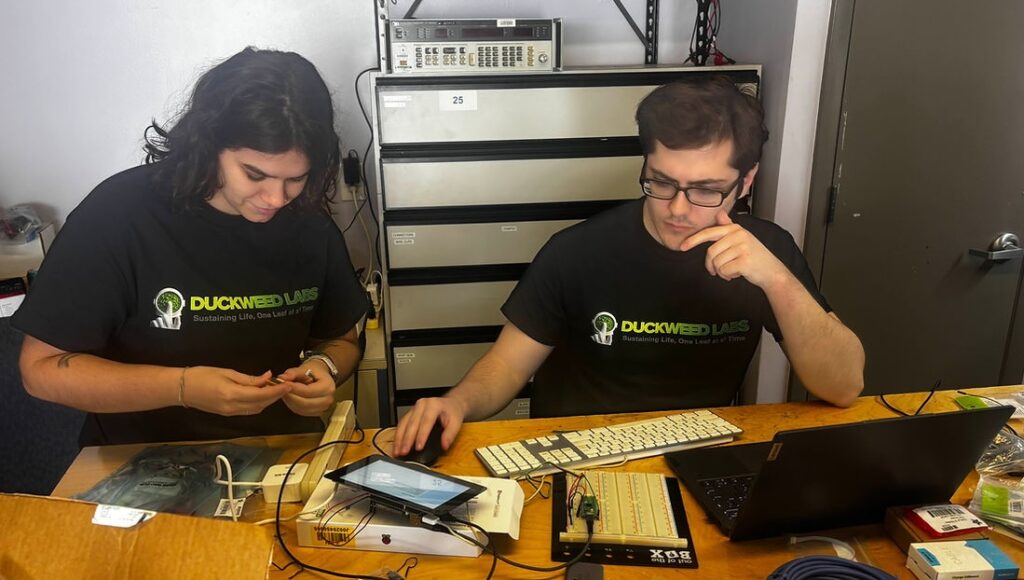
Duckweed R&D workers (credit Duckweed Labs website)
Green Onyx
Duckweed has finally made it to Earth orbit. Agro-tech manufacturer GreenOnyx has announced its flagship product, Wanna Greens (duckweed species Wolffia) was launched into space on SpaceX CRS-29 to the International Space Station (ISS) on November 9, 2023. The Wanna Greens were in a duckweed miniature cultivation module developed by GreenOnyx (Space Botany website).
GreenOnyx’s first set of experiments of duckweed in space aims to explore its rapid growth patterns, high nutrient content, and potential as a sustainable fresh food source for astronauts on long-duration space missions,” said GreenOnyx co-founder and CEO Dr. Tsipi Shoham. (GreenOnyx press release, November 13, 2023)
Other Endeavors
Alex Harkess of the HudsonAlpha Institute for Biotechnology has also been involved in duckweed research with an eye towards astroculture.
The Institute of Agricultural Ecology of Fujian Academy of Agricultural Sciences has been assigned patent CN103477911B on a duckweed growth chamber (Google Patents CN103477911B).
Disclosure: Sustainspace has proposed a Space Super Farm that would have a significant duckweed growing capability. Sustainspace personnel had entered this in 2021 in a NASA Deep Food Competition.
Future Plans and Possibilities for Duckweed in Space
Momentum is building given the recent growth of endeavors working on research and development for growing duckweed into space. This appears to be one of the fastest-building areas in astroculture. With the Space Lab Technology’s planned launch of duckweed to goes on the Moon as part of the Artemis mission, interest will likely increase. Sustainspace analysis suggest that this is one of the most promising possibilities towards feeding astronauts and regenerative eco-systems in space.
References
Alberta Institute for Wildlife Conservation, 2023. Duckweed, A Superfood From The Wetlands. Citing Faculty of Bioscience Engineering, Ghent University, “Animal production systems: Sustainable feed formulations” video. https://www.aiwc.ca/blog/duckweed-a-superfood-from-the-wetlands/
Brine, Josh, and Conor Burke, Duckweed sent to space as part of research into food sources for astronauts, ABC. November 22, 2024. https://www.abc.net.au/news/2024-11-23/duckweed-launched-into-space-research-plant-astronaut-food-moon/104624990
Duckweed Labs website. https://www.duckweedlabs.co/
Google Patents record for CN103477911B. https://patents.google.com/patent/CN103477911B/en?q=(duckweed+microgravity)&oq=duckweed+microgravity
GreenOnyx press release, November 13, 2023. https://www.prnewswire.com/news-releases/wanna-greens-makes-history-as-first-duckweed-plant-launched-into-space-aboard-spacex-crs-29-301985368.html
Pekar, Nancy, Testing Super Foods for Space and More on Blue Origin Suborbital Flight, NASA website. September 23, 2020. https://www.nasa.gov/centers-and-facilities/armstrong/testing-super-foods-for-space-and-more-on-blue-origin-suborbital-flight/
Space Botany, SpaceX CRS-29 Launched Duckweed into Space. November 14, 2023. https://spacebotany.uk/blog/spacex-crs-29-launched-duckweed-into-space/
Space Lab Space Plant Life Sciences page: https://www.spacelabtech.com/space-plant-life-sciences.html
Von Einem, Australian duckweed launches into space, November 13, 2024. University of Adelaide website. https://www.adelaide.edu.au/newsroom/news/list/2024/11/12/australian-duckweed-launches-into-space
Further Reading:
Hunter, Willian, “NASA to grow plants on the MOON: Astronauts will plant cress, duckweed and brassica on the lunar surface on the Artemis III mission in 2026”, Daily Mail. April 1, 2024. https://www.dailymail.co.uk/sciencetech/article-13259545/NASA-grow-plants-MOON-Artemis.html
Knapton, Sarah, “Nasa to cultivate crops on the Moon”, The Telegraph. March 31, 2024. https://www.telegraph.co.uk/news/2024/03/31/artemis-iii-mission-nasa-to-grow-plants-on-the-moon/
Sosa, Diane et al. Lemna minor: Unlocking the Value of This Duckweed for the Food and Feed Industry. May 6, 2024. https://www.mdpi.com/2304-8158/13/10/1435
Space Lab, Christine Escobar | Vice President & CBO. Website: https://spacelabtech.com/about-chris.html
Space Lab Lilypond page: https://www.spacelabtech.com/microg-lilypondtrade.html
uG-LilyPond – Floating Plant Pond for Microgravity, https://techport.nasa.gov/projects/93810