
ESA Closed Loop Life Support

new melissa loop

MELIiSSA loop

The European Space Agency’s MELIiSSA (Micro-Ecological Life Support System Alternative) research program “aims to develop the technology required for a future biological life support system for long term manned space missions.” In fact, MELISSA claims to go “further than other recycling systems used on Mir or the International Space Station which purify water and recycle exhaled carbon dioxide”, by attempting to “recycle organic waste for food production.”

See full article.

Flywheels: Clean Energy Storage?

Flywheel2

Flywheel2

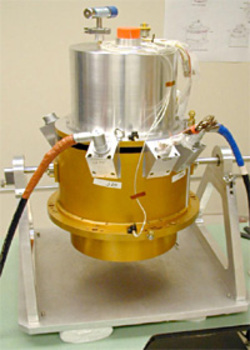
A little known fact is that NASA has a flywheel program. The international Space Station (ISS) is periodically in the Earth’s shadow, so that its solar arrays do not work all of the time. A form of energy storage is required in order to operate the ISS while eclipsed and during peak loads. At one time, NASA had considered using flywheels to store electrical energy on the space station. Like many other NASA programs, the flywheel program has seen better days, but the technology still exists. Much of the research had centered around Glenn Research Center.

See full article.

Clearing the Air with inXitu

Rover on Martian surface

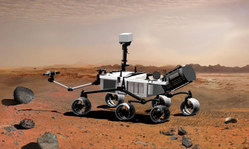
NASA Innovation Partnership Program Director Doug Comstock mentioned inXitu Inc. as an example of an innovative partnership with NASA at the August 5th CoLAB presentation in San Francisco. inXitu develops clean-tech air purifiers and portable material analyzers. The technology used in inXitu’s portable rock and mineral analyzer was chosen to fly on the Mars Science Laboratory rover (upper left) scheduled for launch in 2009.


inXitu has been developing a low-power, passively-cooled, grounded-anode miniature x-ray source to be deployed in miniaturized instruments for surface and subsurface exploration of the solar system. inXitu is also developing solutions targeted for identification and analysis in the areas of explosives, pharmaceuticals, forensics, art and archaeological materials. inXitu‘s new line of instruments will offer performance comparable to laboratory-sized systems with the benefit of portability, significantly reduced sample preparation and reduced cost.

inXitu is also developing a line of low-cost, electronic, pollution prevention devices (PPDs) that will preemptively eliminate nearly all toxic and noxious pollutants from ever entering the atmosphere. Originally designed for NASA as an air purifier for space station use, inXitu has re-engineered the PPDs to provide a simple low-cost device for tackling a wide array of pollutants. inXitu will introduce production units that will be fitted to manufacturing lines, residential air-conditioning units and anywhere highly purified air is needed. Hospitals can use them to provide a safe pathogen free environment for operating rooms and gas stations can fit them on storage tank vents to eliminate a major source of hydrocarbon release.

inXitu’s pollution prevention devices utilize an advanced electron beam source that cleanses air with high-energy electrons. Electron bombardment has proven to be effective in removing a wide spectrum of chemical and biological pollutants. Electron beam systems have a significant advantage over conventional volatile organic compound (VOC) and odor control technologies. The process requires less energy than other purification methods, generates no additional CO2, requires no additional reagents and does not produce any solid or hazardous waste. The breakthrough to meet the restrictive cost, weight and reliability requirements of commercial passenger aircraft and manned space exploration was to replace the thermionic cathode electron emitter with a carbon nanotube (CNT) field emission cathode.

Mslchemin2_5NASA and inXitu each had technology the other party desired. This mutual interest formed the basis of a series of Small Business Innovative Research (SBIR) agreements. Such partnerships allow NASA to share the costs of creating new technology by helping to fund similar research by small businesses. SBIR agreements provide small businesses with critical early stage financing to research new technologies that may not be ripe enough to attract venture capital funding. Regarding the importance of SBIR agreements, inXitu “couldn’t have done it without them,” according to inXitu CEO Scott Snyder. inXitu has developed a series of innovations that has resulted in a corresponding series of new SBIR agreements. In one case, inXitu has even received a coveted SBIR Phase III award due the commercial and strategic importance of some of its technology.

Although the SBIR program is a good way to fund initial development of new technologies, a key barrier is the much greater financing often required for the technology to be developed for commercial use. NASA-initiated venture capital fund Red Planet Capital (aka Astrolabe Ventures) could help provide some of this funding, and other venture capital firms are beginning to be more accepting of environmental technologies.

Middle right: Mars Science Laboratory Chemistry & Mineralogy X-Ray Diffraction (CheMin). Images courtesy of the Jet Propulsion Laboratory.

(Originally published in 2008 in our Sustaianble Reentry blog).

ESA Closed Loop Life Support


Arc arrrows connecting resources in a circular arrangement

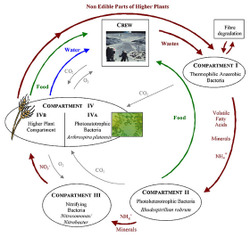
MELIiSSA Loop, courtesy of ESA.

Previous postings have discussed NASA’s Contained Environment Life Support Systems (CELSS), so it’s time to share some of the limelight with the European Space Agency’s MELIiSSA (Micro-Ecological Life Support System Alternative) research program. With MELIiSSA, we bloggers will never need to leave home again assuming there will be a household version someday. All we’ll need is a computer, an internet connection and MELIiSSA, and life will become a carefree, digital bliss.

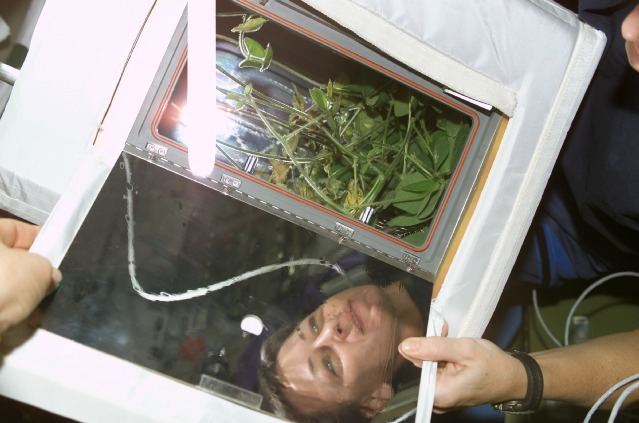
MELIiSSA “aims to develop the technology required for a future biological life support system for long term manned space missions.” In fact, MELISSA claims to go “further than other recycling systems used on Mir or the International Space Station which purify water and recycle exhaled carbon dioxide”, by attempting to “recycle organic waste for food production.” Most of the pictures of MELISSA are not very pretty, but the MELISSA loop schematic (upper left) illustrates MELISSA’s approach. MELISSA utilizes five compartments that provide an entire ecosystem loop from human food production, to human consumption to recycling human wastes:

Compartment 1: The Liquefying Compartment
Compartment 2: The Photoheterotrophic Compartment
Compartment 3: The Nitrifying Compartment
Compartment 4: The Photoautotophic Compartment
Compartment 5: The Crew

What I like about MELISSA is that technology transfer is a built-in phase of the program (Phase 4). Presently, a great deal of biological waste produced by human is not only completely wasted, but becoming a severe landfill and human health problem. MELISSA techhnology can potentially be both scaled up and down to profitably utilize this waste. MELISSA offers some exciting opportunities.

The ESA claims that a Belgian company has already used MELISSA research to “devise methods to remove as much as 85% of the solid waste left over after waste-water treatment and to convert it into water and methane gas, which can be used to generate electricity.” (See ESA posting). The Phase 4 page lists several other examples. For more information on potential opportunities with MELISSA, see Technology Transfer Programme Office.

Notes:
Quotes are from the MELIiSSA website viewed today, unless otherwise noted.
Image: MELIiSSA Loop, courtesy of ESA.

CoLAB Talk on NASA Innovative Partnerships

CoLab logo

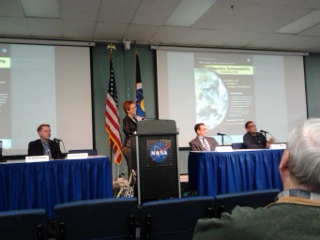
Doug Comstock spoke on “Partnering with NASA: Innovation Through Colloboration” at the NASA CoLAB tenth Luna Philosophie event in San Francisco this evening (Aug. 5) at the Yahoo! Brickhouse. CoLAB is a NASA effort to build direct and open collaborations between the public, and NASA scientists and engineers. Comstock directs NASA’s Innovative Partnership Program. He gave a serious presentation regarding various partnership mechanisms and ended with a high-energy video. That video contained clips from the movie Armageddon which was a small cause for alarm given the recent CoLAB presentation titled “Will An Asteroid Hit the Earth?” Is NASA trying to tell us something?

Comstock mentioned that NASA’s Centennial Challenges are an effective way to bring new participants into NASA research and a cost-effective way to develop solutions to space-related technical challenges. At least two of the Challenges bear upon sustainability: power beaming (Oct 28) and renewable energy (no date set yet).

Worth special mention here for sustainability entrepreneurs are the Small Business Innovative Research (SBIR) and the Small Business Technology Transfer (STTR) Programs. These are a way for small businesses to get NASA funding to develop new technologies. The small businesses retain most intellectual property rights and gain funding without diluting equity.

Since sustainable technologies often require decades to develop, it is difficult to get venture capital (VC) funding at early stages of development. VCs often consider early stage sustainable technologies to be literal science fair projects that do not offer the required quick financial exits. This is because VC funds often exist for only several years and then return the proceeds to investors. So there can be a large time gap between when technologies are conceived and when they are eligible for venture funding. SBIR and STTR funding can be crucial to bridging that gap.

There are other programs worth examining at the IPP as well, including seed funding programs and intellectual property available for licensing. Also, note that the next SBIR/STTR Phase I deadlines are September 4, 2008.